

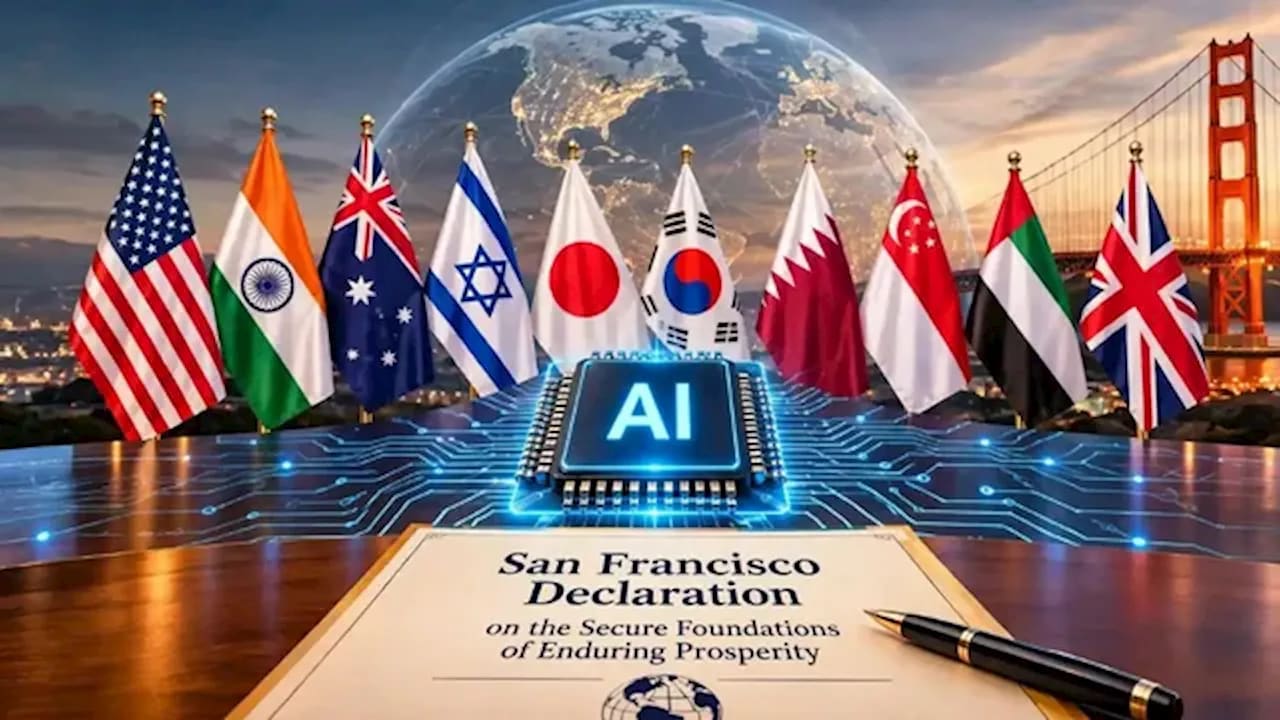
New Delhi, November 17, 2026: India has joined nine other countries in signing the San Francisco Declaration on the Secure Foundations of Enduring Prosperity, a new international initiative focused on protecting the technologies, infrastructure and supply chains that support Artificial Intelligence development.
The declaration was signed on November 15, 2026, during the Pax Silica retreat convened by the United States. It brings together ten countries seeking greater cooperation on the security and resilience of critical technology supply chains.
The initiative comes at a time when Artificial Intelligence is becoming increasingly important to economic growth, national security, semiconductor manufacturing and digital infrastructure.
Which Countries Have Signed the Declaration?
The San Francisco Declaration has been signed by representatives of ten countries:
- United States
- India
- Australia
- Israel
- Japan
- Republic of Korea
- Qatar
- Singapore
- United Arab Emirates
- United Kingdom
The participating countries have recognised that the security of AI technology is closely connected to the security of their economies and critical infrastructure.
The declaration describes the protection of sensitive technologies and essential infrastructure as a shared responsibility.
Why Is AI Supply Chain Security Becoming Important?
Developing advanced AI systems requires much more than software and data.
It depends on a complex global ecosystem involving:
- Semiconductor chips and advanced processors.
- Critical minerals and raw materials.
- Semiconductor manufacturing equipment.
- Data centres and high-performance computing systems.
- Energy infrastructure and electricity networks.
- Telecommunications and digital connectivity.
- Logistics, transportation and international trade.
A disruption in any important part of this ecosystem could affect AI development and the delivery of digital services.
For example, a shortage of advanced semiconductor components could delay data centre construction. Similarly, restrictions on critical minerals or disruptions to international logistics could affect the manufacturing of technology equipment.
The declaration seeks to encourage cooperation among participating countries to make these supply chains more secure and diversified.
Five Working Groups Proposed for Technology Cooperation
One of the important elements of the declaration is a proposal to establish five areas of cooperation through working groups.
These include:
1. Pro-Innovation Policy Frameworks
Countries will explore policy approaches that encourage innovation while addressing security concerns around sensitive technologies.
2. AI Adoption in Key Sectors
The initiative aims to support the adoption of AI across important industries and economic sectors.
3. Supply Chain Cooperation Across the AI Stack
This area focuses on improving cooperation across the different stages of AI development, including semiconductor design, manufacturing, components and infrastructure.
4. Safe Harbours and Supply Chain Security Hubs
The proposed area focuses on developing cooperation mechanisms that can support trusted technology supply chains and security arrangements.
5. AI Security and Resilience
Participating countries intend to strengthen the security and resilience of AI systems and the infrastructure that supports them.
The declaration outlines these cooperation areas, but their practical implementation will depend on subsequent discussions and actions by participating governments.
What Does the Declaration Mean for India's Semiconductor Industry?
India has been working to strengthen its domestic semiconductor and electronics manufacturing ecosystem.
The country wants to expand its capabilities in chip design, semiconductor manufacturing, advanced computing and technology infrastructure.
Joining the declaration could provide India with another platform to cooperate with international partners on critical technology supply chains.
Potential areas of cooperation include:
- Access to trusted semiconductor supply chains.
- Collaboration in advanced chip technologies.
- Critical mineral sourcing and processing.
- AI infrastructure development.
- Technology research and skilled workforce development.
- Protection of critical digital infrastructure.
For India, the opportunity is not limited to importing technology. Stronger international cooperation could also support domestic manufacturing, research and the development of Indian technology companies.
Readers can also explore SalasarMedia's coverage of IndiaAI Mission's EKA-1 and Dhīr models, which highlights India's efforts to build AI systems suited to domestic requirements.
Critical Minerals and Semiconductor Manufacturing at the Centre
Critical minerals are essential for several modern technologies, including electronics, batteries, advanced manufacturing and semiconductor-related supply chains.
Countries increasingly view access to these materials as an important economic and strategic priority.
Semiconductor manufacturing also requires specialised equipment, materials, technical expertise and reliable infrastructure.
The declaration highlights the importance of protecting these resources and reducing excessive dependence on concentrated supply chains.
This could become particularly relevant as demand for AI computing continues to grow.
How Could This Affect Global Technology Companies?
The declaration may have implications for companies involved in semiconductor manufacturing, AI infrastructure, cloud computing, telecommunications and critical minerals.
Technology businesses could see greater attention on:
- Supply chain transparency.
- Security standards for critical components.
- Trusted technology partnerships.
- Data and infrastructure protection.
- Diversification of manufacturing and sourcing locations.
Companies developing AI hardware and data centre infrastructure may also need to pay closer attention to geopolitical developments and international technology policies.
For a broader understanding of the companies shaping this sector, readers can explore SalasarMedia's report on NVIDIA's growing influence in AI computing and semiconductor technology.
Is the San Francisco Declaration a New AI Law?
No. The San Francisco Declaration should not be confused with a new AI regulation or a domestic law.
It is an international declaration outlining shared priorities and cooperation among participating countries.
It does not, by itself, establish a single global AI regulator or automatically impose new legal obligations on every technology company.
Further government-level discussions, policies and implementation measures will determine how the proposed cooperation develops.
This distinction is important because international technology declarations often establish strategic direction before specific programmes or regulatory measures are introduced.
What Happens Next?
The next stage will involve turning the declaration's broad objectives into practical cooperation.
Participating countries will need to discuss how to coordinate supply chain security, identify critical technologies, encourage investment and strengthen infrastructure resilience.
For India, the outcome will be particularly important as the country continues to develop its semiconductor ecosystem and expand its role in the global AI industry.
The success of the initiative will ultimately depend on whether the participating countries can translate their shared commitments into measurable progress.
Conclusion
India's participation in the San Francisco Declaration marks another development in international cooperation around Artificial Intelligence and critical technology supply chains.
By joining the United States and eight other partner countries, India has become part of a group seeking stronger cooperation on semiconductors, critical minerals, AI infrastructure and technology security.
The declaration does not immediately create new AI laws, but it establishes a framework for future collaboration.
As global competition in AI and semiconductor manufacturing increases, secure supply chains and trusted technology partnerships are likely to become increasingly important for India's digital and industrial growth.
Disclaimer: This article is based on reporting and the published declaration available as of November 16, 2026. Proposed cooperation areas should not be interpreted as completed programmes or binding domestic regulations.