
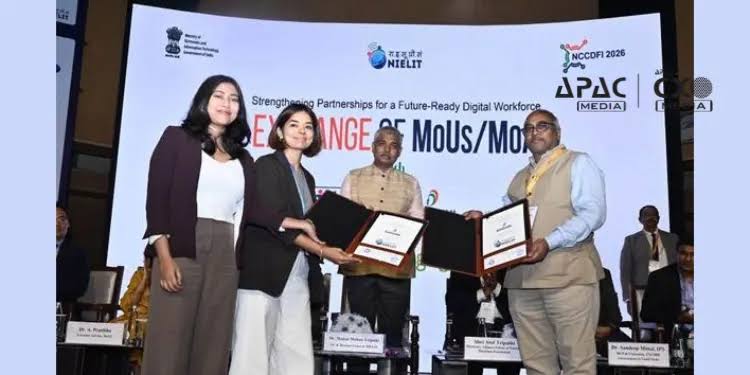
New Delhi, November 20, 2026: India is expanding the use of Artificial Intelligence in technical education through a new partnership between the Digital India BHASHINI Division and the National Institute of Electronics and Information Technology (NIELIT).
The two organisations exchanged a Memorandum of Understanding (MoU) on November 19, 2026, to promote multilingual AI applications, technology education, research and skill development.
The initiative aims to reduce language barriers that prevent students and learners from accessing technical knowledge, digital learning resources and emerging technology courses.
The collaboration will combine BHASHINI's multilingual AI ecosystem with NIELIT's expertise in electronics, information technology, education, research and technical training.
What Is the BHASHINI–NIELIT Partnership?
The collaboration has been established under the BHASHINI for Seva/Sanchalan – A BHASHINI Sahayogi Programme.
Its objective is to explore how AI-powered language technologies can be integrated into educational and institutional systems to make technical learning more accessible.
Under the partnership, the organisations will explore opportunities to introduce multilingual AI tools into NIELIT's educational, training and institutional ecosystem.
The proposed activities include:
- Multilingual access to educational and technical learning resources.
- AI-powered translation of course content.
- Speech-based technology and language solutions.
- Digital platforms supporting learners in Indian languages.
- Research and development of domain-specific language resources.
- Capacity-building programmes for students, educators and technology professionals.
The initiative is intended to help learners access emerging technologies without language becoming a major barrier.
How Multilingual AI Could Transform Technical Education
Many technical courses, programming resources, software documentation and technology tutorials are primarily available in English.
Students who are more comfortable learning in Hindi, Tamil, Bengali, Telugu, Marathi or other Indian languages may face additional difficulties when studying complex technical subjects.
Multilingual AI can help address these challenges by supporting translation, speech recognition and language-based interaction.
For example, AI-powered tools could potentially help learners:
1. Understand Technical Courses in Their Preferred Language
Educational content could become more accessible through translation and multilingual explanations.
Students may be able to understand technical concepts more easily when learning materials are available in languages they are comfortable with.
2. Access AI-Powered Voice Learning
Speech technologies could help learners interact with educational systems using spoken language.
This may be particularly useful for students who face difficulties navigating text-heavy digital platforms.
3. Improve Access to Digital Skills
Multilingual learning resources could support education in areas such as:
- Artificial Intelligence and Machine Learning.
- Programming and software development.
- Electronics and hardware technologies.
- Cybersecurity.
- Data science.
- Digital literacy.
4. Support Skill Development Beyond Major Cities
Students in smaller cities and rural areas may benefit from more accessible digital learning resources.
Language-based AI tools could help expand access to technical education and professional training opportunities.
BHASHINI's Growing Multilingual AI Ecosystem
BHASHINI is India's national initiative focused on AI-powered language technologies and multilingual digital inclusion.
The platform supports translation, speech technologies and language-based digital services designed to make technology more accessible across linguistic communities.
According to the government's announcement, BHASHINI's ecosystem currently supports:
- 36 Indian text languages
- 23 Indian voice languages
- 35 international languages
- More than 800 government websites
- Over 11 billion AI inferences enabled
- More than 24 million AI inferences processed daily
These figures highlight the scale at which multilingual AI infrastructure is being developed and deployed across India's digital ecosystem.
The partnership with NIELIT could help extend these capabilities into technical education and skill development.
Why NIELIT Is Important in This Initiative
The National Institute of Electronics and Information Technology is involved in electronics, information technology education, research and skill development.
Its training and institutional network provides a potential pathway for introducing multilingual AI technologies into educational programmes.
By combining language technology with technical education infrastructure, the partnership could support a broader range of students, educators and professionals.
The collaboration may also encourage research into language technologies designed specifically for technical subjects, where terminology and accuracy are particularly important.
AI Could Make Technical Learning More Inclusive
Artificial Intelligence is increasingly being used in education through personalised learning platforms, automated translation, voice assistants and digital tutoring systems.
However, access to these technologies is not equal for every learner.
Language remains an important challenge, particularly when students need to understand specialised technical concepts or interact with digital platforms.
Multilingual AI could help make digital education more inclusive by allowing users to interact with technology in their preferred languages.
The impact will depend on the accuracy of translations, the quality of speech recognition, the availability of relevant learning material and the ease with which students can use these tools.
India Is Expanding AI Applications Across Multiple Sectors
The BHASHINI–NIELIT partnership is part of a broader effort to expand AI applications across education, governance, financial services and public infrastructure.
India has been exploring multilingual AI for citizen services and digital access, including partnerships involving financial education and public-sector institutions.
Readers can explore SalasarMedia's earlier coverage of BHASHINI's partnership with SEBI to improve multilingual access to investor education and India's indigenous AI foundation models.
These developments demonstrate how India's AI strategy is moving beyond general-purpose applications towards specialised solutions designed for different industries and user needs.
What Happens Next?
The MoU establishes a framework for cooperation, but specific projects, integrations and deployment timelines will depend on further implementation decisions.
The organisations are expected to explore practical ways to integrate multilingual AI technologies into learning platforms, educational material, research and institutional services.
The effectiveness of the partnership will ultimately depend on the quality of the tools developed, their adoption by students and educators, and the ability to provide accurate technical content in different languages.
Conclusion
The partnership between Digital India BHASHINI and NIELIT represents another step towards making technology education more accessible across India's linguistic landscape.
By exploring multilingual AI, translation, speech technologies and digital learning solutions, the initiative aims to reduce language barriers in technical education and skill development.
If implemented effectively, it could help students from diverse backgrounds access emerging technologies and participate more actively in India's growing digital economy.
Disclaimer: This article is based on the government announcement dated November 19, 2026. The MoU outlines areas of cooperation; specific deployments, timelines and outcomes remain subject to implementation.